What is a Wild Sensitive?
September 13, 2026 | Posted in Living Hartfully | By Gaia Hart
As I’ve been writing about Highly Sensitive People and High Sensation Seekers, a Wild Sensitive is a term coined by authors Randy Grasser and Annet van Duinen to describe what is otherwise known as a Sensitive Sensation Seeker. The community understands it is a mouthful to always say the entire descriptor of our unique traits that have paradoxically blended together to form our life’s foundation, hence the term Wild Sensitive. Those with this trait have a need for deep reflection and a craving for new experiences. Recent research has shown even more evidence of differences in the brain of Sensitive Sensation Seekers/Wild Sensitives.
If you’re not already familiar with these terms – first read the last few blog posts describing the four characteristics each of Highly Sensitives and High Sensation Seekers, then this will make much more sense. Sensitivity is not the problem, misunderstanding it or even knowing it exists is the issue and society’s interpretation of it is a problem. Though there does come some struggle along with the strengths it provides. Some struggles may include burnout and overwhelm, boundary setting, heightened emotional reactivity, social exhaustion and over-stimulation. The book covers strategies to handle these struggles as well as how to foster the strengths of deep empathy and emotional insight, creativity and rich imagination, detail-oriented perception and intuition, and strength of ethical awareness and social conscientiousness. If these traits sound familiar to you – YOU NEED THIS BOOK.
To quote their book The Wild Sensitive, “Sensitivity is not a weakness. Craving life is not a flaw. You were never meant to simply fit in. You were meant to awaken, to feel deeply, to grow wisely, and to live wildly: This is where your journey begins. This is where you become a Wild Sensitive”. The book’s intro goes on. “It is not a contradiction, but a potent combination. When these traits are seen, understood, and embraced, they become the foundation for real, embodied, transformation.”
Their Wild Sensitive book describes the science behind sensitivity and sensation seeking. It is a guidebook for learning about the Sensitive Sensation Seeking trait with many tools for using when you are feeling overwhelmed, along with explanations of why/how this happens, understanding your emotional blueprint, and strategies for coping with dysregulation. It covers the Six Zones of Life, The Adventure Triskelion, relationships and leadership of the Wild Sensitive and how you can make your way through the world armed with better knowledge of how your traits work together to form your superpower and not your downfall.
The Wild Sensitive: Unlocking the Power of the Highly Sensitive Sensation Seeker
by Randy Grasser (Author), Annet van Duinen (Author), Tracy Cooper Ph.D (Foreword)
Written by Randy Grasser and Annet van Duinen, pioneering authors specializing in the Highly Sensitive Sensation Seeker (HSP-HSS), this guide explores the powerful combination of Sensory Processing Sensitivity and High Sensation Seeking, creators of The Wild Sensitive. Drawing on lived experience, research, and practical insight, it offers a new understanding of what it means to feel deeply and live boldly.
I cannot begin to explain what insights this book has brought to my life. I usually dog-ear the top corner of the pages of a book that speak to me, then I dog-ear the bottom corner if it REALLY speaks to me and then I may highlight a sentence. Well…. I stopped dogearing all the pages after the first several pages because it was nearly every single page, AND I was not only highlighting sentences and paragraphs, I started putting highlighted stars and exclamation points and multiple stars and exclamation points on specific paragraphs. I felt like Annet and Randy were in my brain and in my life and had the incredibly insightful, professional, therapeutic terms, explanations, diagnostic tools and prescriptions for dealing with this quite perplexing complexity of being a Highly Sensitive Person as well as a High Sensation Seeking Extroverted Empath. There just wasn’t anything on the market out there perfectly describing my lifestyle, my inherent traits and how to cope, manage, and organize my life to support my internal and external self.
Yes, they use the word WILD, but that doesn’t mean reckless or that you need to be sky diving and bungee jumping – though that is what I’ve been drawn to, it can mean your sense of boldness and expression – writing a book, singing, being a public speaker, traveling to foreign countries, learning a new language. If you or anybody you know is Highly Sensitive, but seem larger than just being sensitive, they do things that make them feel ALIVE and they get bored easily or are more disinhibited than others, then tell them about this book. AND send them to the websites the authors have initiated to create a community of fellow Wild Sensitives where we can learn and discuss in a safe space. Here are their sites: https://wildsensitive.com/ and the village community site: https://village.wildsensitive.com/
What is a Highly Sensitive Person? Resources for You to Find Out.
March 14, 2026 | Posted in Living Hartfully | By Gaia Hart
After watching the Prime Video Documentary Sensitive: The Untold Story, intuitively I knew I had to learn more about this thing called a Highly Sensitive Person and I dove in headfirst into everything I could find on the topic. How could it be that I’d been in the self-help, professional development, personal enrichment, coaching field for decades as a certified facilitator of several personality trait instruments, and I’d never heard of such a thing.
It was Dr. Elaine Aron who started researching the topic of High Sensitivity, officially known as Sensory Processing Sensitivity as a trait in 1991 and it further rolled out in the later 1990s and has been growing in understanding ever since. HSP is not a disorder nor a disability. It is a trait that some would call a superpower that 20-30% of the population exhibits with further breakdowns in percentages as you combine High Sensation Seeking and a lower percentage of Extroverts vs. Introverts with this trait. It can be explained using the acronym DOES. Here is a brief example representing each of the letters with an expanded explanation on Dr. Aron’s site HSPerson. Be sure and read her books and workbooks as well to give you a jump-start into your journey – found on her site.
- Depth of Processing: Do you reflect more than others about the way the world is going or any other topic, need a little more time to make decisions, known for good ideas and thoughtful internal dialog?
- Over Stimulation: Do you experience overstimulation and burn out due to sheer amount of incoming information, need a quieter/calmer environment to think and process, need more sleep or downtime to recoup?
- Empathy & Emotional Responsiveness: Are you more easily moved to tears of joy, gratitude, relief or equally moved to laughter, do you tend to react with emotions similar to others – you catch their emotions and feel similarly, are more distressed by violence, horror, bullying in TV shows/movies, or are disturbed more than others by social injustice, unfairness, arguing?
- Sensitive to Subtleties: Do you notice details other normally miss, or sense how somebody may feel, if things are out of sorts or if décor is moved around, more aware of small environmental or house noises and temperatures, susceptible to humidity and temperature changes, textures, tastes, light and sounds?
You can read more about her research, find resources, take the self-assessments to see if you are a Highly Sensitive Person or a High Sensation Seeker on her website HSPerson.com. She also has a link to the first-ever documentary film series covering the topic of Highly Sensitive Men called Sensitive Men Rising that was just released in the past couple years – so this is a new and burgeoning area of study. The resource page on HSPerson has many other books and articles: HSPerson. Here’s a link to the Sensitive Men Rising site.
I found a guide who was also a High Sensation Seeking, Highly Sensitive Person who could customize my learning curve specifically tailored to my life. Having her was an invaluable resource in shortening the time it took me to get up to speed and understand how knowing of these traits and how they fit together and fit into every single area of my life was essential to moving forward making the right decisions for me to live more attuned, content, and awakened to what I need in my life to fully support who I am and who I am becoming. It was also an amazing experience to reframe so many experiences in my former years, why they affected me in such a manner, and how not to become dysregulated and burned out in the future.
Another favorite resource I read regularly is the Highly Sensitive Refuge blog. They offer oodles of articles on all topics concerning Highly Sensitive People and I find it extremely helpful. I always have it pulled up on my phone to read while in waiting rooms for one thing or another. It’s positive and has impactful tips that you can implement immediately.
More Than Decluttering & House Hushing – It’s Space & Mind Hushing
March 4, 2026 | Posted in Living Hartfully | By Gaia Hart
Good ideas and styles stick around and are recycled by another name when the latest people to learn about it tack on another moniker and call it a new idea. That’s exactly what happened with getting rid of extra stuff and living more minimally and organically – something I covered in my first book Hit Any Key to Energize 30 years ago. Getting rid of stuff became decluttering, then Marie Kondo’ing if it didn’t spark joy out it went and now I’m seeing headlines that house hushing is all the rage with a bit of a different flavor. There really isn’t a need to move everything out of a room — who’s got time for that and who has the extra space.
Our environment we create represents the environment going on in our minds. It’s the outward expression of the clutter we have between our ears. If you’re working on quieting the noise on the inside and doing “the Work” with a capital W, then you need to take a look at your environment and what you’re surrounding yourself with. I’m guessing there’s more visual pollution than you’d like. A good place to start is to stop your unfettered consumerism, stop the ads coming into all of your mailboxes and dare I say it – stop scrolling to see what you absolutely must have, because odds are you can likely survive without it. Try creating the Scandinavian vibe of Hygge – cozy, comfortable, comforting, smells good, not too much stuff, streamlined to suit your needs without the tchotchkes to dust around.
Get ruthless in your pursuit of not buying stuff – ensure that whatever comes into your space has purpose (if not several purposes) and meaning. Dig deep into how you feel when you’re in your space. Is it supporting who you are now and who you are becoming or just who you were back in the day. Our space needs to change as we grow and change. I can’t tell you how many color phases I’ve been through during my lifetime and I cringe at some of them now. For me, at one point about 10 years ago, I had an enormous craving for bright colors in my wall hangings, so I combed through all of my travel photos and found ones that had more colors that made me very happy. Bonus is that they brought back such good memories that I now only have my travel photos and art on my walls to remind me of good times in over 100 counties.
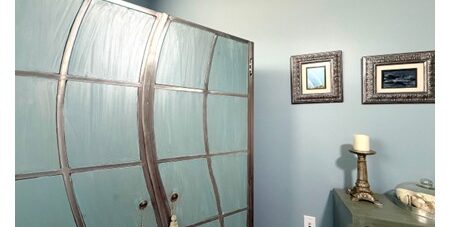
When I moved to the California coast, I ditched my European antiques which worked so well overseas and in colonial Virginia but looked out of place at the beach. I ended up with very whimsical, artsy furnishings that were a perfect fit back then. Years later, the amount of many colors felt too brash, so I painted all of my furniture in a similar color and I painted all of my frames in a pewter wash to give my brain a rest from all of the color stimulus. I also have color-drenched some rooms so that the walls and ceiling are more soothing.
You see, I was working on intuition back then and what I now know is that it was my sensory processing sensitivity at work. My brain was on overload – overstimulated by too much color and variations of shapes and stuff and the lines of the furniture. My brain was working too hard to process all the shapes, colors, and stuff. Because us Highly Sensitive People are deep processors, our brains get tired if there is too much stimulation in our environment to process.
Even my books started to bug me. I tried arranging them by size, color, stacking them – nothing worked. What I found is that I need them behind a cabinet door – out of site so my brain gets a rest. This goes for sounds as well. I once lived in Florida on the water and the sound that carried across the water drove me nuts. I could hear every sound that came from the homes across the water and especially the mowers and blowers at all hours of the day every single day. It was like having jet engines revving up all day outside your window. Insanity for me. I now live where they do our lawns all at one time and I hear the mowers and blowers for about one hour 2-4 times per month in season and nothing but birds in the off-season.
Living in the Washington DC area was very toxic for me and my mental and physical health. Necessary for the work I was doing, but damaging my soul. The constant buzz of activity, helicopters, traffic, density of living, too many people crammed into small spaces, constant commotion and too much cement. Not to mention the toxic political stench that forever hangs in the air. Once Covid hit, I moved out to a smaller town to work remotely and retire/rewire in a bucolic, laid-back, slower-paced environment that is much more supportive of a stress-free daily lifestyle.
Listen to your body and get a gut feel for what bugs you in your space. Be militant about what you allow into your home and create a calming, quiet, supportive space that doesn’t hold bad memories from past lives. Yes, Marie Kondo did have a good idea about things sparing joy – but be honest with yourself about what ACTUALLY gives you joy. And for goodness sake, don’t spend money on a storage unit – just get rid of that extra stuff and stop worrying about it and paying for it. More is not necessarily what you need to be happy, healthy, peaceful, and calm. With all the hectic stuff going on in the world, your home needs to be your sanctuary – what can you do to make it so? Don’t forget pleasant music in the background to help soothe your mind. I haven’t listened to radio in over a decade. The noise of the announcers, traffic reports, and advertisements were assaulting on my ears. Choose your noise wisely so it doesn’t harsh your mellow as we used to say back in the day.