Thrill: Sensitive Sensation Seekers & Everyday Creativity
September 10, 2026 | Posted in Living Hartfully | By Gaia Hart
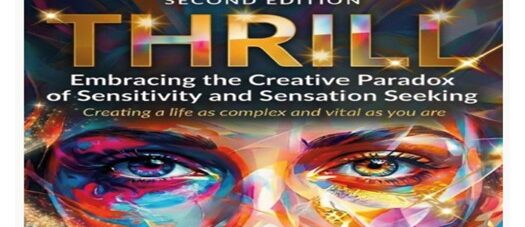
Dr. Tracy Cooper, Ph.D. one of the leading authorities and researchers on Highly Sensitive People and High Sensation Seekers known as Sensitive Sensation Seekers, https://drtracycooper.org/ has brought us more gems of ground-breaking research in his second edition of Thrill as an addition to his first edition of Thrill: The High Sensation Seeking Highly Sensitive Person. The 2nd edition is filled with even more recent intelligence on Sensitive Sensation Seekers. His latest books Thrill (2nd Edition): Embracing the Paradox of Sensitivity and Sensation Seeking is a completely different book than the first edition – not just a rewrite. This 2nd edition takes the reader to new levels of understanding based on his and other recent research into the paradox of living with both traits of being a Highly Sensitive Person and a High Sensation Seeker.
He simultaneously wrote a companion book to the 2nd edition covering 25 Sensitive Sensation Seekers from around the world at all life stages and ages with in-depth interviews of how these Sensitive Sensation Seekers have created their lives to embrace their paradoxical traits, even if they didn’t know they had them or even know what it meant to be a Highly Sensitive Person or a High Sensation Seeker. The companion book is called Thrill: Everyday Creators.
If you want to take a deeper dive into the why, what, and how others have embraced their perplexing complexity of traits to strategically manage their lives and create a life of design and not default, then you need both of these books. The 2nd Edition of Thrill gives you the research, the WHAT and the WHY. The companion book on Everyday Creators lets you take a peek behind the curtain of HOW others with these traits have survived, fallen, thrived, flailed, and succeeded by trial and error in their iterative process to learn how to live with the duality of depth and daring, security and seeking, with one foot on the gas and one foot on the brake.
These are not How-To books, because the how is very personalized depending upon the individual, their specific trait properties, context, interests, lifestyles and choices. Each individual must forge their own way forward, testing the waters of overstimulation and under-stimulation/boredom to test their own personal tolerances for keeping themselves in balance and in the flow state unique to them. These books are imperative reading for those who think or know they have the paradoxical traits of being a Highly Sensitive Person and a High Sensation Seeker in order to better understand yourself and how you move through the world and how to adapt everything in your life at every level so you can maintain your equilibrium and avoid overwhelm as well as boredom.
I am humbled and honored to be one of those 25 people interviewed for the companion book on how I managed to creatively design my life around traits I didn’t know existed until I was 60 – totally living by intuition and trusting what my body told me for many decades. My hope is that you find these books and Dr. Cooper’s research in your younger years so you can understand yourself and your needs and how to create a life that will support your special traits where you need both meaningful stimulation and time to recover. These traits are your super power. The very act of designing a life and a career in an artful way to best support your gifts/talents/skills is the very act of being a creative.
Review of the 2nd edition of Thrill: Embracing the Paradox of Sensitivity and Sensation Seeking. Thanks to Dr. Cooper’s research, insight, and guidance, the act of designing your life can be distilled to the art and science of creating your individual flow between overstimulation and boredom based on your personal tolerances. His book gives you a structure on which to overlay your personal traits to create optimal life experiences. It’s your secret decoder ring for any Sensitive Sensation Seeker who wants to solve your individual puzzle to create a supportive structure as the architect of your life. This book gives you the sides and corner pieces of the puzzle and it’s up to you to fill in your own picture of how you want your life to look.
In this new edition of Thrill, Dr. Cooper’s brilliant, ground-breaking research breaks down how Highly Sensitive People and High Sensation Seekers use the tension between the paradox of living in the flow between over-stimulation and overwhelm on one side and boredom/under-stimulation on the other side. They often cross over the line into overwhelm or boredom for that is the nature of the beast – trying to learn where your personal boundaries are for each of the states. For some Sensitive Sensation Seekers with a lower volume of intensity or perhaps only one or two of the four characteristics of a High Sensation Seeker and a low volume of High Sensitivity or Sensory Processing Sensitivity, their path between overwhelm and boredom may be a wide walking path.
For Sensitive Sensation Seekers with a high volume in all four categories of the Sensation Seeking trait, there is a thin tightrope of flow between the states of overwhelm and underwhelm. Those with high scores in both the Highly Sensitive inventory and the High Sensation Seeking inventory often bump up against and cross over into these other states, as their tolerance is much more narrow in order to remain balanced in the flow state.
Sensitive Sensation Seekers are driven to feel that inner aliveness and creative processing tension between how we take in the world through our sensitivities and how we express to the world through our sensation seeking. The need for novelty, challenge, experimentation, surprise and excitement needs to be balanced with regrouping, rest, processing time, and recovery time to protect the sensitivities. It is through this balancing act we find the tension that enables creativity. It’s the dissonance that creates energy and emotional energy that can get stuck in the body without proper expression.
It’s a constant iterative recalibration to test tolerances and what works to both protect and project your energy in nearly all circumstances. We need to discharge those emotions and feelings and transfer them outside of our body to avoid the stuck energy, which can lead to more stress, strokes, depression, heart attacks, disease (dis-ease), agitation, irritability, etc. The higher the emotion and intensity of the tension between your paradox of sensitivities and sensation seeking tendencies, the more cognitive load you have to discharge to dissipate the overload/over-stimulation and regulate back to your equilibrium.
If there is more tension, (from far too much stimulation or if you have a high volume of Sensation Seeker and Sensitivity traits) you may first need bigger energy releases and exertion such as heavy weightlifting, running, biking, soccer, dancing or other types of movement to lower the tension and intensity of dissonance. If there is less dissonance and less intense tension between your paradoxes, then you may need calmer methods of discharging the creative energy that has built up by doing art projects, napping, reading, cooking, creative writing, petting an animal, playing with your pet or organizing your closet as a way to dissipate the tension and get back in balance and into the flow state.
What can be good for you can also be bad for you if you overdue it. You may find weightlifting is your go-to move, but too much of it can lead to injury or you may find yourself bored with the same routine. The methods of movement you choose to bring yourself out of boredom or out of overwhelm is highly individualized and highly contextual for the same person. It’s something that has to be felt and experienced by each person and in each circumstance and you learn more as you go through life and learn what works best for you to keep you in the flow state of equilibrium and balance.
To maintain creative capacity, Sensitive Sensation Seekers need to offload the cognitive load and discharge the intensity of the excess energy and restlessness of overwhelm, which can be done through various creative processes, rhythm and movement to move from restlessness to calm, from the amygdala to the prefrontal cortex for executive functioning. Knowing that what feeds you can also wear you out is a game changer for keeping you in the flow state of emotional regulation through creative expression to bring your system back into balance and back into flow, particularly for those with the highest paradox intensity, it is essential. Read this book and your Sensitive Sensation Seeking life will never be the same.
Review of Thrill: Everyday Creators. This companion book to the 2nd edition of Thrill: Embracing the Paradox of Sensitivity and Sensation Seeking offers real-life situations from in-depth interviews with 25 Highly Sensitive, High Sensation Seekers from around the world in various life stages and ages to present the reader with real-life examples and experiences of those who are living with the complex and perplexing paradox of being both Highly Sensitive and High Sensation Seeking. This companion book gives you examples of the HOW of living with both of these traits affects all aspects of your life and shows how others are living with discernment about knowing what excites them and what it costs afterwards and there is always a cost. It shows how others live in the stretch zone and what it looks like to visit the panic zone and how they recovered from it.
It’s a delicate balance between immersion in the excitement/challenge/novelty/intensity and the type and amount of recovery that is needed afterwards to keep Sensitive Sensation Seekers in the flow and learning what has to be included to attune to each person’s specific frequency of paradox intensity to avoid overstimulation or boredom. This book shows you how others have done it, have done it wrong, are doing it right and share their stumbling blocks so you can use them as your stepping stones to remain in the creative flow of all areas of life. I highly recommend reading the research-based book first, then the companion book for examples of how others have lived their experiences often without having any knowledge of sensitivities. Use their experience as your guard rails and use Dr. Cooper’s ground-breaking research as your guide. Your life will not be the same after gaining insights from his two latest books.
Books by Dr. Tracy M. Cooper, Ph.D. – one of the leading authorities and researchers on Highly Sensitive People and High Sensation Seekers. https://drtracycooper.org/
Thrill – Everyday Creators companion book
Thrill (2nd Edition): Embracing the Paradox of Sensitivity and Sensation Seeking
Stretch Your Creative Muscle
October 23, 2015 | Posted in Leading Hartfully, Living Hartfully | By Gaia Hart
Creativity is one of those things many people thing they don’t possess. They may have had it as a kid and it was “conformed out of them” in the academia and workplaces unless you chose a creative field. If you ask a room full of children if they can draw, all hands go up. If you ask a room of adults the same question, only a few hands raise. What’s the deal with that? When did we lose it? I think it’s still there, but hasn’t been exercised in a while and has become flabby.
When faced with unique conditions, I would like to think we could get creative and figure out a way just like the astronauts did when they were in trouble, or like Cheryl Strayed in her book Wild about hiking the Pacific Crest trail solo. I can relate to that after spending 30 days in the wilderness on an Outward Bound backpacking experience. Necessity is the not only the mother of invention, but I think the other child is creativity. I try to exercise my creativity daily through art, photographs, cooking, sewing, designing décor, designing training and activities, and problem solving. If I don’t get a chance to exercise my creative muscle, I get antsy and itchy to do something, anything creative.
The following are six conditions which allow creativity — and ultimately, innovation — to flourish.
Solitude. Not withdrawal or being totally alone, but in the sense of spending time apart from the clichés and conventions of society to focus on one’s own thoughts and ideas.
Inactivity. Not loafing or goofing off, but planned inactivity as a break in one’s busy routine. I’ve known people to regularly set aside part of their daily schedule so as not to be interrupted in their thoughts.
Daydreaming. Daydreaming can be focused on out of box thinking and is often connected to inactivity. In daydreams, we make mental excursions into fantasy that breed creative activity. Several organizations have quiet rooms set aside for the purpose of stimulating out-of-box thinking. Reading magazine outside your normal arena to get ideas from other industries is a fascinating way to daydream. I also find watching the house hunter home shows from around the world helps me get ideas.
Gullibility. This is the willingness to suspend one’s personal beliefs and accept what comes from inside without insisting on rationality or logic.
Alertness and discipline. Although these qualities are necessary for productivity in any endeavor, they also have a special meaning in creativity.
Mental replay. Allowing oneself to revisit past creative efforts and resolution of past traumatic conflicts leads to analogies.
While most of the conditions require loosening of control and openness to the inner self, the last and most important quality is the willingness to put whatever you discover into action. What are you going to put into action to exercise your creative muscle?
What Colors Can Do to Specialize Your Space and Affect Your Mood
November 8, 2013 | Posted in Living Hartfully | By Gaia Hart
Colors have a powerful effect on mood, and work their magic spell by helping us get in touch with our emotions. Colors can soothe, inspire, energize, and rejuvenate, and they set the mood and atmosphere of a room. So what is your home doing for you? Is your living room a drab den or a sensational salon? What about the bedroom? Is it a run-down retreat or a palace of passion? And what changes can you make to ensure that your living spaces are working for you? Understanding the rules of color and mastering the secrets of color mixing will help you create the right mood for your rooms. There are no rights and wrongs — the most important things are to have fun and to be creative. And the simplest way to revitalize your home is with paint.
Color wheel. Do you want warm or cool, dramatic or neutral? The color wheel is an invaluable tool for choosing the hues, tints, and shades based on your personal preferences. An unlimited amount of color combinations are possible. The wheel is divided into 12 equal sections, each displaying a primary, secondary, or tertiary color. The “warm” and “hot” colors are on the right hand side of the wheel, and the “cool” and “cold” colors are on the left. Black, white, and grey are the neutral colors, and don’t appear on the color wheel.
Primary colors. These are the three key colors that cannot be formed by any combination of other colors — red, blue, and yellow.
Secondary colors. When you mix equal amounts of two primary colors you get secondary colors — purple, green, and orange.
Red + Blue = Purple
Red + Yellow = Orange
Blue +Yellow = Green
Tertiary colors. Mixing primary colors with secondary colors in a 2:1 ratio will produce tertiary colors — red-orange, yellow-orange, red-purple, blue-purple, blue-green, and yellow-green.
How to use the color wheel:
Knowing the colors that harmonize and work with each other will help you create a tasteful theme and avoid making a rainbow riot. Here are some basic color schemes to get you started:
Complementary colors are found opposite each other, such as red and green or yellow and purple. They always go well together, hence the term complementary, and are easy on the eyes.
The meaning of colors:
Green. Bountiful in nature, the color green is life, growth, and health — a reassuring sign of renewal and regeneration. Situated in the center of the spectrum, green brings balance and order. The eye makes no adjustment to accommodate green striking the retina, making it a restful and soothing color.
Pink. Gentle and soft, delicate and feminine, pink quietly nurtures and soothes. It is the tender side of red, and invokes feelings of romance and enchantment. Bright pinks are energetic and youthful, while vibrant pinks are full of passion, though they are not as aggressive as reds.
Orange. Warm and sensuous, orange represents ripeness and happiness. It is a fun and exhilarating color that promotes feelings of excitement and hope. Orange is a combination of red and yellow, and shares common traits with both. It is forceful and demands attention, but is less intense than red, being mellowed by the presence of yellow.
Brown. Natural and organic, down-to-earth, and neutral. Though sometimes saddled with a reputation for being boring, brown is representative of wholesomeness and goodness, and promotes feelings of stability and order. It is simplicity in a chaotic world. Lighter shades are particularly soothing, while darker hues are confident and dependable.
Red. The color of passion, romance, love, and lust. Red is hot, fiery, and tempestuous — a powerful and intense color that evokes a sense of urgency and excitement, and stimulates the heart to beat faster. Red demands attention and will bring out the extrovert in you. It’s not for the shrinking violets.
Blue. Cool and calming, blue symbolizes serenity, purity, and loyalty. In many cultures blue has an important role in religious belief as a bringer of peace. Darker shades project an image of power and authority — police uniforms are blue, and a blue power suit is a favorite of the corporate world. Lighter shades are refreshing and uplifting — they encourage creativity and stimulate the imagination.
Purple. Full of magic and mystery, purple is the color of royalty, and represents opulence, wealth, luxury, and magnificence. Balancing hot red and cool blue, it has the properties of both. Purple can be uplifting, and is a soothing balm to mind and nerves. It also offers a sense of spirituality, and it symbolizes intuition and imagination.
Yellow. Representing the warmth and radiance of the summer sun, yellow is energetic, vibrant, cheerful, and optimistic. It’s the good mood hue, and shines with hope, happiness, and joy. Yellow enhances the intellect, activates the memory, and aids communication and concentration.
Upgrading your living spaces:
There are plenty of other ways to bring a burst of color into your life without the use of a paintbrush.
Living room
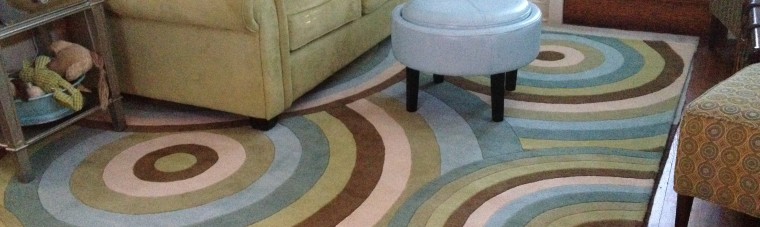
Use these additions to make your dream living room warm, cozy, and inviting. I found a wild rug and I mean wild in color and pattern and just HAD to have it. It so happens that it perfectly matched the cicles design on my chairs and my apple-green wild couch. Something happened on my way to being “of a certain age” that I replaced all my silk Chinese traditional dark green rugs with some crazy patterns and fun colors. Guessing I’m feeling like a freer spirit and can decorate however I want and this makes me happy…it’s light and luscious.
- Decorative throw pillows and cushions — add some fresh color and a touch of style and vitality.
- A colorful painting or digital photographs — take a few snaps in the park or around town, and frame the best images to create your own art.
- Colored pillar candles, plates, and vases — place on a sideboard or table, and think of grouping them in threes. Objects look more interesting in groups than on their own.
- Flowers — let nature enhance your living space.
Bedroom
- Your decision of whether you want your bedroom to be a passion palace or a blissful oasis will determine your color choice.
- Layer your room with linen — use embroidered sheets, satin quilts, pleated cotton bed skirts, and cozy and colorful drapes.
- Change the lighting — buy colored lampshades and painted light bulbs.
- Rugs — add to your room’s rich and lush appeal.
- Artwork — buy a huge canvas or print or hang your own creations.
Bathroom
Your bathroom is a serene sanctuary, and there are some simple ways of adding sparkle to your cool, calm oasis.
- Accessorize — consider a decorative mirror, colorful containers, pictures, matching towel sets, and decorative towel bars.
- A colorful rug — freshen up the floor.
- Color-changing faucet — provide quite literally a splash of color, as the water changes color as it runs through the faucet.
Colorful tricks
- To make a room appear larger — paint all surfaces with the same color from the warm end of the color wheel. Paint the ceiling a lighter shade to make it appear higher. Large furniture appears smaller if it is the same color as the walls.
- To make a room feel cozier — use colors from the warm end of the color wheel. A warm color on the ceiling will make it feel lower, and therefore comfier and more intimate.
Service & Self Care First, Clients Second

March 23, 2010 | Posted in Leading Hartfully, Living Hartfully | By Gaia Hart
Comments Off on Service & Self Care First, Clients Second
I know the saying is usually the customer comes first. But I have to take issue with that. Just like the oxygen masks from the ceiling, put your mask on first before you can help others.
If we serve and take care of ourselves first, taking care of our health, wealth and vitality, then it will resonate with others who are feeling the same way. If we are feeling burned out, rusted out and about to give out; what kind of clients do you think will resonate with that? If we are starving and struggling, how can we be feeding and leading? We must serve ourselves first in order to be strong, healthy and vital before we can show others the way.
Do we want to attract the low vibrational folk? Maybe we do, if our service is to help them raise their vibration. But the deal is, it’s not just clients you attract when you’re at a certain vibration, it’s everybody and everything.
We may have learned early on that taking care of ourselves first is selfish. I shout from the rooftops that we need to take care of ourselves and guard our energy fiercely, or else we won’t have any to give away. You can’t give what you don’t have. So we must have our vitality and energy first, then give it away to others and help them find their own.
For instance, creating is like breathing for me – it’s so reflexive. If I can’t be creating something, anything (articles, sewing, cooking, decorating, art, programs), I get antsy. That is why it’s critical for me to guard my morning time as fiercely as I guard a meeting with a VIP, by the way, that’s ANYBODY.
I know if I don’t get ‘me time’ to create, I’m cranky and I can’t rebuild my energy stores. I know my body rhythms and I’m the most creative in the morning and brain dead